
What is DARVO?

Canva image
Did you have a family member, partner, or friend who gaslit you? Did they make up false stories about you? Did you find yourself questioning your own reality? If you did, this may be what they wanted.
What you went through may be a classic example of DARVO.
DARVO is a manipulation tactic. It is what many offenders do when confronted with their wrongdoing. Three things happen. First, they deny or minimize what they did. Then, they go on the offensive and attack the victim’s credibility. Third, they blame the victim for the violence or harm. A study showed that perpetrators who used DARVO influenced the victim’s own self-blame.
Psychologist Dr. Jennifer Freyd first introduced this term in 1997. She explored DARVO as a mechanism for silencing victims. It was related to her formulation of betrayal trauma theory.
Naming these patterns of behavior can help survivors have the language to describe the complexities of what was done to them. Being able to name DARVO can help survivors take back what was stolen from them.
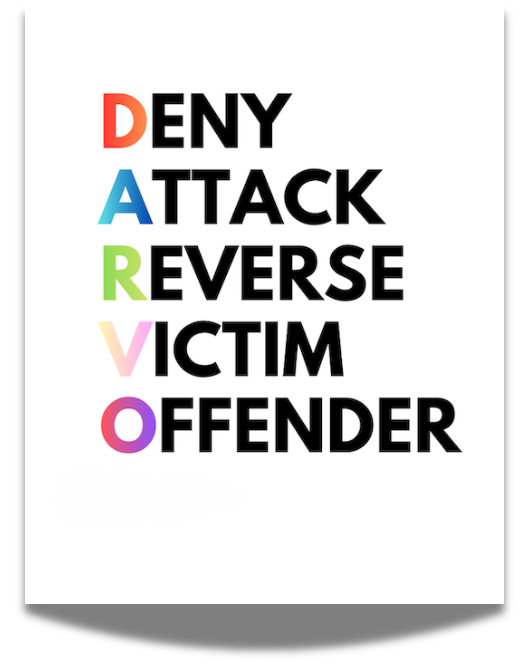
design by Amy Gunter 2026
Victim Blaming
Just before I left home at fourteen, my mother convinced my father and brothers that I was a bad person. She twisted the facts to make herself look like the victim. Instead of admitting her wrongs, she denied attacking me. This is not uncommon for many perpetrators of interpersonal violence.
The aggressor denies or minimizes what they did. They want to avoid any accountability for their actions. I’ve seen this cycle repeated time and time again.
Perpetrators blame the victim who was harmed. When someone else believes the lies, it can cause a second layer of trauma.
DARVO revictimizes victims. The blame compounds the shame that the victim may already feel for being violated.
Being attacked, harassed, or assaulted can take a serious toll on the victim’s mental health. In DARVO, the person causing the harm questions the victim’s credibility. They may spread lies to tarnish the victim’s reputation. This causes more pain for the victim, especially when their family or friends believe the lies.
An Experience with DARVO
We see DARVO playing out globally. Some leaders deny what they did, even when there is video evidence. Instead of taking responsibility, they claim their victims asked for it.
Before reporting, victims wrestle with whether to report. They fear retaliation. Victims want to be believed when they report how they were abused. Victims stay silent when they do not feel safe reporting.
When my mother lunged towards me and shoved me into a solid wood kitchen table and chairs, she fabricated a lie. In her story that she told my family she made me the offending party. This was before I even had the chance to tell my side of the story.
For me, that betrayal hurt even more than the physical attack.

created by author in Canva
How to Reclaim Your Reality Right Now
When you face DARVO, you may feel like you’re nervous system is under attack.
These 3 free Beyond Survival coping cards can help you.
[ Send Me the 3 Free Beyond Survival Cards ]
Naming the Truth to Heal
Years after this experience with DARVO, I found a therapist I felt safe talking to. Participating in therapy helped me work through my pain and understand my past in a new way. Those first healing experiences are part of what led me to become a healer myself.
As a professional, I have studied Dr. Freyd’s research on DARVO. Learning about this concept changed my life. I now had the words to describe my complicated feelings about what was done to me.
Once I could name it, I understood: it was never about me.
Now, when I see DARVO, I can call it out instantly. Naming it helped me to feel validated. Like someone understood my pain. My hope is that other survivors feel some relief in being able to name it, too.
We can finally pause, breathe, and think: “Ah, this is DARVO.”
If you are dealing with DARVO, remember it’s not your fault, insteadfault;:
Focus on your truth, not a false story about your character.
Do not accept a version of events that twists your truth.
Ask for perspective from a trusted person or therapist outside the situation.
Remind yourself: people who avoid accountability are often afraid of facing their own actions.
A 5-Step Guide to Rewrite Your Narrative
DARVO can feel deeply confusing. At first, it was hard to rewrite my own story. With continuous practice, it became easier. When the emotional trance rolls in, you can move through these five coping steps:
1. Notice what is happening inside your body.
2. Accept your feelings instead of pushing them away.
3. Ask yourself what is true for you.
4. Give yourself compassion.
5. Rewrite the ending on your own terms.
Pause. Notice. Feel.
Notice what is happening inside your body right now. Watch your thoughts roll by like waves in the ocean or clouds moving across the sky. Do not judge them.
All feelings are okay. Fighting your feelings can turn pain into longer suffering. When we accept our feelings, we can begin to accept ourselves.
Ask yourself: Where are these thoughts coming from?
Get 3 free Beyond Survival coping cards here.
The full set will be released in June 2026.
References
Freyd, J. J. (1997). II. Violations of Power, Adaptive Blindness and Betrayal Trauma Theory. Feminism & Psychology, 7(1), 22-32.
Harsey, S., & Freyd, J. J. (2020). Deny, Attack, and Reverse Victim and Offender (DARVO): What Is the Influence on Perceived Perpetrator and Victim Credibility? Journal of Aggression, Maltreatment & Trauma, 29(8), 897–916. https://doi.org/10.1080/10926771.2020.1774695
Harsey, S. J., Zurbriggen, E. L., & Freyd, J. J. (2017). Perpetrator Responses to Victim Confrontation: DARVO and Victim Self-Blame. Journal of Aggression, Maltreatment & Trauma, 26(6), 644–663. https://doi.org/10.1080/10926771.2017.1320777
Sarah Harsey & Jennifer J. Freyd. (2020) Deny, Attack, and Reverse Victim and Offender (DARVO): What Is the Influence on Perceived Perpetrator and Victim Credibility?. Journal of Aggression, Maltreatment & Trauma 29:8, pages 897-916.